

How Much Money Does Puerto Rico Make
In May 2017, the federal board filed Puerto Rico's bankruptcy, the largest ever in the $3.8 trillion municipal-bond market. Four months later on September 2017, Maria hit the island, destroying its electrical grid and stopping its economy dead.
The main government expenditures are on health, education and welfare.
Credit Rating
Standard & Poor's credit rating for Puerto Rico stands at D with negative outlook. (Aug 03 2015)
Finance
There are currently 19 commercial banks in Puerto Rico, most of them local corporations. Local banks institutions includes: Banco Popular, which is considered the largest banking institution in the island, with over one hundred branches throughout the island, Banco de San Juan, and Banco Mercantil de Puerto Rico; and branches of US: Citibank and FirstBank; and foreign banks: Banco Bilbao-Vizcaya, and Banco Santander, the second largest bank in Puerto Rico. The government owns and operates two specialized banks- the Government Development Bank (GDB) and the Economic Development Bank (EDB).
Banks offer a wide range of products and services such as checking and savings accounts, CDs, IRAs, loans, credit and debit cards, and electronic banking. Automatic teller machines are abundant, commonly referred to as ATHs. Banks are insured by the Federal Deposit Insurance Corporation. They are subject to all Federal controls applicable to banks in the United States of America.
Stock Market
Puerto Rico does not have its own Stock Market, and many of its larger corporations are listed on U.S. stock markets. On June 15, 2004 Popular, Inc. become the first Puerto Rican Financial Company to open the Nasdaq Stock Market.
Currency
United States dollar (USD)
Since Puerto Rico is part of the United States, the island's currency is the US dollar. Puerto Rico relies on the U.S. government to print money and to manage the money supply via the U.S. Federal Reserve and the Central Bank.
The US dollar is divided into 100 cents (¢) and referred by locals as "peso".
Coins: 1¢, called the centavo or chavito (penny); 5¢, called the vellón or ficha (nickel); 10¢ (dime); 25¢, called the peseta (quarter); and the seldom-seen 50¢ (half-dollar) coin and $1.
Bills: $1, $2, $5, $10, $20, $50, $100, $500, $1,000, $5,000, and $10,000. On July 14, 1969, the Treasury Department and the Federal Reserve Board announced that they would immediately stop distributing currency in denominations of $500, $1,000, $5,000 and $10,000. Production of these denominations stopped during World War II. Their main purpose was for bank transfer payments.
Market Value Stats
Gross National Income (GNI per capita) (formerly GNP per capita): $70.8 billion (2019)
per capita: $22,160 (2019)
Puerto Rico is classified as a high income country, high income countries are defined by the World Bank as countries with a Gross National Income (GNI) per capita of $11,116 or more.
Interesting Fact
The Gross Domestic Product, or GDP, measures the amount of goods and services (economic activity), measured at market prices, and produced within the country during a particular time period (usually a year). The Gross National Income, or GNI (formerly Gross National Product, or GNP), is the amount of goods and services produced by residents of a country, regardless of where that production takes place. In other words, the GDP is the value of the goods and services produced within the country, while the GNI is the value of goods and services produced by citizens of a country. For example, when an American company generates profits from a production in Mexico, these profits would be counted towards the U.S. GNI, not towards the Mexican GNI. Yet, these same profits will be counted as part of Mexican GDP, not the U.S. GDP, because the production takes place within geographic boundaries of Mexico.
Gross Domestic Product (GDP) - purchasing power parity - $105.0 billion (2019)
$130 billion (2017 est.)
GDP (official exchange rate): $104.2 billion (2017 est.)
GDP - real growth rate: 1.5% (2019)
-2.4% (2017 est.)
GDP - per capita (purchasing power parity): $32,871 (2019)
$39,400 (2017 est.)
| Country | 2000 | 2008 | 2009 | 2010 |
|---|---|---|---|---|
| Puerto Rico | 10,000 | 18,100 | 17,400 | 16,300 |
| United States | 36,200 | 48,300 | 46,700 | 47,400 |
| Jamaica | 3,700 | 8,800 | 8,500 | 8,400 |
| Cuba | 1,700 | 9,700 | 9,800 | 9,900 |
Puerto Rican workers are covered by the U.S. Federal Fair Labor Standards Act (FLSA) are subject only to the Federal minimum wage ($7.25) and all applicable regulations. Workers not covered by the FLSA will be subject to a minimum wage that is at least 70 percent of the Federal minimum wage or the applicable mandatory decree rate, whichever is higher. Labor costs are below the mainland average, but are higher than in other areas of the Caribbean Basin.
Gross Domestic Product: real growth rate - -0.6% (2013 est.)
- GDP - composition, by end use:
- household consumption: 87.7% (2017 est.)
- government consumption: 12.2% (2017 est.)
- investment in fixed capital: 11.7% (2017 est.)
- investment in inventories: 0.5% (2017 est.)
- exports of goods and services: 117.8% (2017 est.)
- imports of goods and services: -129.8% (2017 est.)
- GDP - composition by sector:
- agriculture: 0.8% (2017 est.)
- industry: 50.1% (2017 est.)
- services: 49.1% (2017 est.)
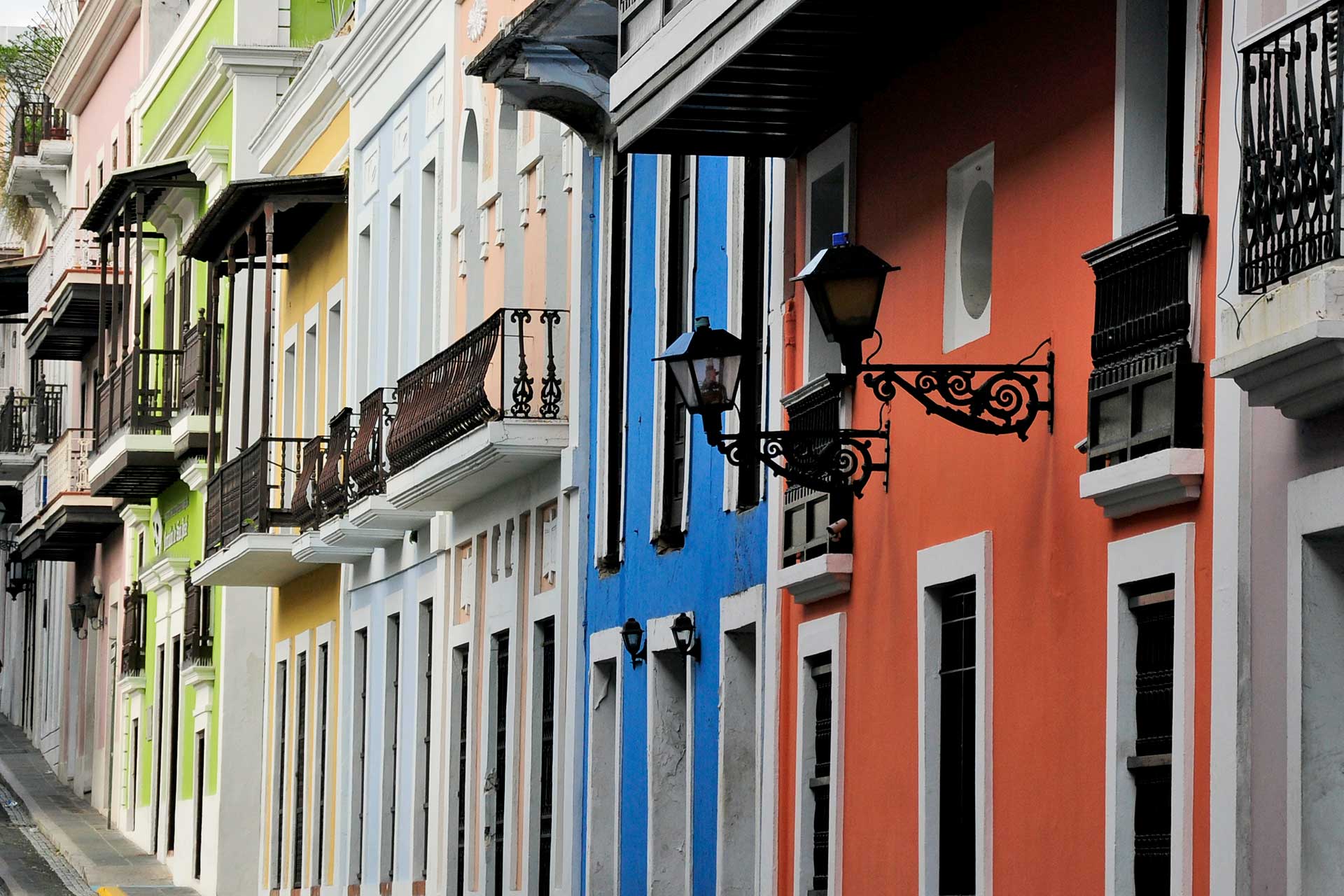
Old San Juan
Labor Stats
Labor Force: 1.1 million of persons 16 years and over (2020)
1.081 million (November 2018 est.)
Labor force - by occupation: Services: 35.2%, Trade: 23.4%, Government: 17.2%, Manufacturing: 10.2%, Construction: 4.7%, Transportation and other public utilities: 4.1% Finance, insurance and real estate: 3.6%, Agriculture: 1.6% (2019)
Construction Growth: 15% (1997 est.)
Construction is currently one of the most dynamic activities in Puerto Rico's economy. Since the mid-1980s, the construction industry has grown faster than most other economic sectors, helping to sustain the overall growth of the economy.
Organized Labor:
115,000 members in 4 unions; the largest is the General Confederation of Puerto Rican Workers with 35,000 members (1983).
Unemployment Rate: 8.6% (2020)
7.7% (December 21, 2018)
Average Hourly Wage: $8.08/hour, well below the U.S. average.
Minimum Wage Rate (per hour): $7.25 (2016)
Basic Minimum Rate (per hour): $2.13 to $5.12. (2016)
Population Below Poverty Level: 43.5% (2019)
43.1% (2018)
According to the US Census Bureau - that's nearly double the poverty rate in Mississippi, the most impoverished of the fifty states.
Interesting Fact
What is the poverty income level?
The U.S. Department of Health and Human Services and U.S. Census Bureau both record poverty statistics for the United States, but they each have their own calculations for the poverty income level.
The poverty guidelines are not defined for Puerto Rico, the U.S. Virgin Islands, American Samoa, Guam, the Republic of the Marshall Islands, the Federated States of Micronesia, the Commonwealth of the Northern Mariana Islands and Palau.
Puerto Rico uses its own poverty level which is significantly lower than the FPL - roughly equal to half of it.
In February of each year the U.S. Department of Health and Human Services (HHS) issues the Federal Poverty Guidelines in the Federal Register. These poverty guidelines are one version of the federal poverty measure.
The poverty level as defined by the HHS in 2017 was $20,420 a year for a family of three, or $24,600 for a family of four.
Another version by the Census Bureau, calculates the poverty thresholds using the federal Social Security Administration's official poverty definition, who coincidentally works with the HHS in the administration of certain programs.
The poverty level as defined by the Census Bureau in 2017 was $29,360 a year for a family of five.
- Households and Families
- Median Household Income: $19,775 (2017)
- Total Households: 1,261,325 (2016)
- Average population per family: 2.81 (2013-2017)
- Average population per household: 2.98 (2000)
Inflation Rate (consumer prices): -1.60% (August of 2020)
1.8% (2017 est.)
-0.3% (2016 est.)
Commercial bank prime lending rate: 4% (31 December 2016 est.)
3.3% (31 December 2015 est.)
Food Inflation -1.10% (July of 2016)
Taxes
Puerto Rico general sales and use rate increased from 7% to 10.5% with an effective total tax rate of 11.5% on many transactions when combined with the municipal sales and use tax of 1% (as of July 1, 2015). Puerto Rico now has the highest sales tax in America. In addition, in the event that the governor determines an insufficiency in collections for the general fund an additional 1% to the central government will be imposed.
All inbound shipments to Puerto Rico are subject to a local excise tax. Merchandise and/or articles arriving from the U.S. that will be sold, consumed, given away, and/or remain in Puerto Rico are subject to a 6.6% Puerto Rico excise tax that is calculated from the commercial invoice value. This is payable upon entry to Puerto Rico.
Puerto Rico has it own tax system. Although it is modeled after the U.S. system, there are differences in law and tax rates.
The Puerto Rico tax system is based on self-assessment. Taxes are paid to the state, most Puerto Ricans don't pay federal income taxes, but they do pay Social Security, Medicare, import, export and commodity taxes. Individual taxpayers are required to file an annual income tax return when minimum-income thresholds are met. They report taxable income and deductions, compare their final tax liability to any income tax withheld or estimated tax paid, and determine any balance due or overpayment of tax due from the Treasury.
For information about the filing taxes in Puerto Rico contact the Bureau of Income Tax at the following address:
- Negociado de Asistencia
- Contributiva y Legislación
- Departmento de Hacienda
- P.O. Box 565
- San Juan, Puerto Rico 00902-6265
- (787) 721-2020, ext. 3611
To obtain tax forms, contact the Forms and Publications Division Office at the above address or call (787) 721-2020, extensions 2643, 2645, or 2646 or visit the Internal Revenue Service web site.
These forms are also available online along with the other tax forms, instruction booklets, etc. To obtain these forms visit the Departmento de Hacienda web site.
Corporate Tax Rate 39% (Nov 2016)
Personal Income Tax Rate 33% (Nov 2016)
Exports and Imports
Exports: $63.7 billion (2019)
$73.17 billion (2017 est.)
$70.41 billion (2016 est.)
Export Commodities: Pharmaceuticals, chemicals, medical equipment & supplies, computers, electronics, electrical equipment, food, machinery. (2020)
Export Partners: US 75.7%, Netherlands 4.2%, Italy 2.9%, Belgium 2.8% and Spain 1.8%. (2019)
Imports: $49.4 billion (2019)
$49.01 billion (2017 est.)
$47.61 billion (2016 est.)
Imports Commodities: Pharmaceuticals, chemicals, petroleum products, food, computer and electronic products, motor vehicles, machinery, plastics and rubber products, electrical equipment. (2019)
Imports Partners: US 49.9%, Ireland 12.6%, Singapore 5.1%, South Korea 4.9% and Switzerland 4.0%. (2019)
External Debt: $56.82 billion (31 December 2010 est.)
Public Debt: 51.6% of GDP (2017 est.)
Debt - external: $56.82 billion (31 December 2010 est.)
country comparison to the world: 59
Revenues:
$31.3 billions (Consolidated Budget) (FY-2010)
increase $13.1 billions (Net Revenues, Commonwealth) (FY-2010)[11]
Expenses:
$29.1 billions (Consolidated Budget) (FY-2010)
decrease $10.2 billions (Commonwealth) (FY-2010)
Industries
Manufacturing accounts for 46.4% (2010) of GDP: manufacturing of pharmaceuticals, chemicals, machinery, electronics, apparel, food products, instrument, textiles, clothing, and tourism.
Manufacturing:
Puerto Rico's manufacturing sector has shifted from the original labor-intensive industries, such as the manufacturing of food, tobacco, leather, and apparel products, to more capital-intensive industries, such as pharmaceuticals, chemicals, machinery, and electronics. Major manufacturing activities in the order in which they contribute to the manufacturing domestic income are chemical and allied products, machinery and metal products, food and kindred products, apparel and related products, printing and publishing, leather and leather products, stone, clay, and glass products, tobacco, paper and allied products, and textile mill products.
San Juan and Mayagüez are the leading centers for making clothing.
Manufacturing Average Hourly Earning: $7.85
Manufacturing Average Weekly Earning: $310.86
Percentage of Manufacturing Employment by Industry Group:
Chemical and allied products 18.2%, Apparel and other textile products 15.5%, Electronic 15.2%, Food and kindred products 13.2%, Instruments and related products 9.8%, Paper and related products 4.7%, all other manufacturing 23.3%
Resources: (1999)
- Fuel Purchase: 35,631,482 barrels
- Fish: 7,493,000 pounds
Total value: $16,791,000 - Livestock: 38,680,000 pounds
Total value: $31,908,000 - Minerals: Mining activities are limited to quarry operations
- Electricity: Annual energy production: 20.9 billion kWh (2001)
- Total capacity: 5390 megawatts/hour
Energy:
Oil is the dominant fuel in Puerto Rico's energy mix, accounting for 97.7% of total primary energy consumption (0.35 quadrillion Btu) in 1999.
- Motor Gasoline: 2,550,000 metric tons coal equivalent
- Electricity: 1,690,000 metric tons coal equivalent
- Energy Consumption: 2,493 kwh per capita
Electricity Costs:
The cost of electrical services in the industrial sector depends on the consumption and the kind of service provided. (example for services provided under 50 KVA included below)
- monthly charge = $5.00
- energy per KW/hr = $0.065,
- fuel adjustment charge per KW/hr = $0.034858
Industrial Production Growth Rate: -2.1% (2017 est.)
Tourism:
Number of tourists: 3.07 million (2018)
Receipts from visitors: U.S. $3.28 billion (2018)
Receipts per tourist: $1,070 (2018)
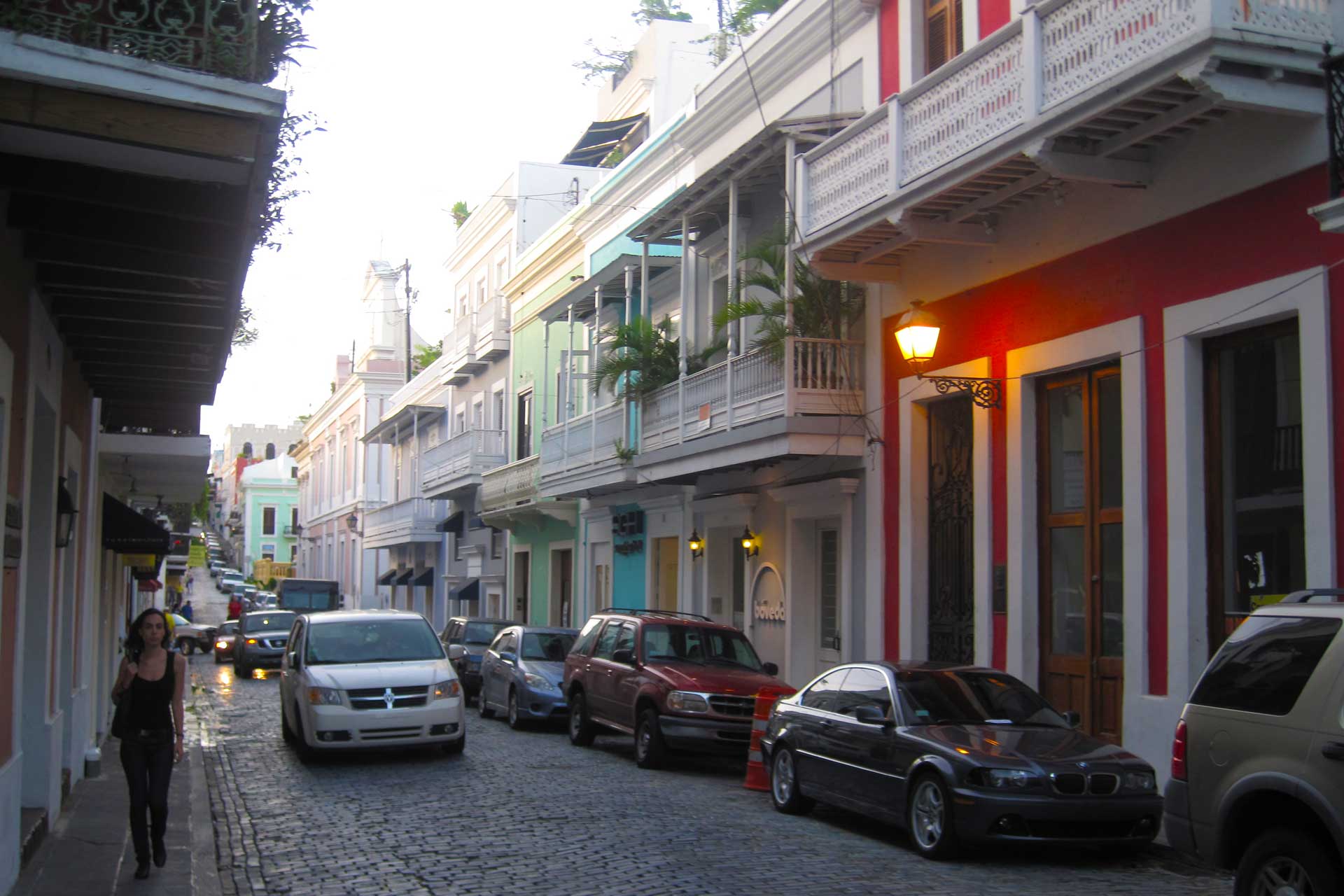
Old San Juan
Agriculture:
Until 1955, agriculture constituted Puerto Rico's main economic sector. Sugar cane, mostly for export to the American market, was the main crop, followed by coffee and tobacco. Sugar cane production declined as prices remained low, agricultural labor migrated to the United States, and urban expansion took over much sugar cane land. Coffee production, taking place mostly in the mountainous areas away from the pressures of urban expansion and supported by guaranteed minimum prices, has remained stable. Tobacco production has virtually disappeared. Considerable expansion has occurred in the production of dairy products, beef, pork, eggs, and poultry, although significant amounts of these products are still imported, primarily from the United States. There is also production of fruits and garden vegetables as well as of starchy vegetables, such as bananas and plantains.
Today, agriculture accounts for only 3% of labor force and less than 1% of GDP, concentrating primarily to crops which can be sold in the United States. Coffee is the most valuable crop, followed by vegetables, sugar cane, fruits (pineapples, plantains, bananas), milk, eggs, and livestock (cattle, chickens, pork).
Interesting Facts
- Migration has played a large role in social and economic changes since the 1950s. In the 1950s and 1960s, the government encouraged a massive migration of poor agricultural workers to the east coast of the US to help create a predominantly industrial economy. The number of Puerto Ricans is now about equal to the island's population.
- Puerto Ricans are another immigrant group that has had a significant impact on the economy and culture of New York since World War II. Several hundred thousand reside in the state, mostly in New York City. After a heavy immigration of Puerto Ricans during the 1950s and early 60's, the growing economic strength of Puerto Rico led to a considerable reduction, with those entering the state being largely offset by those returning to Puerto Rico.
- Some of the best-educated young people leave because of better opportunities and labor conditions on the mainland.
- Statistics show that it has some of the most favorable economic conditions; the gross national product (GNP) is growing much more rapidly than the population, and the GNI per capita (formerly GNP per capita) is one of the highest in the Caribbean, but in comparison with the United States, Puerto Rico is still below that of the poorest state in the mainland, Mississippi. In 1989, Puerto Rico received 72 times more food stamps than Mississippi, half the island's population currently receives food stamps.
Economic Aid: none
Economic Development:
Economic Development Administration (Administración de Fomento Económico) 787-758-4747
Puerto Rico Industrial Development Company 1-888-577-4326
Small Business Administration 787-766-5572
Books
- Economic History of Puerto Rico
- The Political Economy of Colonialism: The State and Industrialization in Puerto Rico
- Puerto Rico: The Trials of the Oldest Colony in the World
- Teodoro Moscoso and Puerto Rico's Operation Bootstrap
Other Resources
- Origins of the Puerto Rico Fiscal Crisis
- A Glance at Puerto Rico's Economy, September 2001, Government Development Bank of Puerto Rico (PDF)
- Economy at a Glance - Puerto Rico
- Gross State Product > Current Dollars (per capita) (most recent) by state
- Here's how Puerto Rico got into so much debt
- Poverty: 2008 and 2009 (PDF)
- Puerto Rico 1997 Economic Census of Outlying Areas Manufacturing - Issued March 2000, U.S. Census Bureau, 1997 Economic Census (PDF)
- Puerto Rico 1997 Economic Census of Outlying Areas Wholesale Trade, Retail Trade, Service Industries - Issued December 2000, U.S. Census Bureau, 1997 Economic Census (PDF)
- Puerto Rico Department of Labor and Human Resources
- Puerto Rico Economic Indicators
- Puerto Rico Economic Indicators, July 2, 2003, Government Development Bank of Puerto Rico (PDF)
- Puerto Rico's Economic Trends & Outlook, June 2003, Government Development Bank of Puerto Rico (PDF)
- United States vs. Puerto Rico Quality of Life Comparison
How Much Money Does Puerto Rico Make
Source: https://welcome.topuertorico.org/economy.shtml
Posted by: paulsonfristruither.blogspot.com
0 Response to "How Much Money Does Puerto Rico Make"
Post a Comment