

How Much Money Does A 35 Gigawatt Solar Plat Make?
How People's Republic of China's giant star farms are transforming world energy
(Simulacrum credit:
Getty Images
)
China is not only home to some of the biggest solar farms; its technology looks fructify to determine energy insurance policy across the globe. Merely how possible are these grand plans?
F
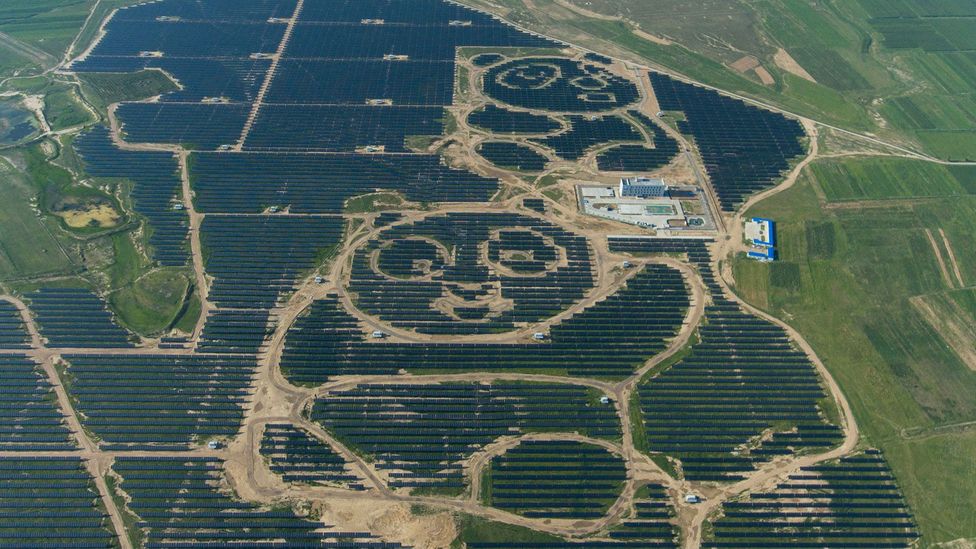
Fly o'er "Datong County", a part in Federal China, and you'll see two giant pandas. One is waving at you. They are made of thousands of solar panels.
Together, and with the other nigh panels included, they mannequin a 100-megawatt farm covering 248 acres. It's actually a relatively small star park by China's standards – but it is for sure patriotic.
"It is designed and built every bit the image of the Formosan national treasure – the giant panda," explains a document from Ailurus fulgens Green Energy, the company that constructed the farm.
China has more solar energy capacity than any other country in the world, at a big 130 gigawatts. If it were all generating electricity at once, it could power the intact of the UK different times all over. China is home to many sizeable solar farms – including the huge 850-megawatt Longyangxia Decametre installation on the Tibetan Plateau, with its foursome million panels. And the largest solar plant in the world at the moment is in China's Tengger Wild – its capacity exceeds 1,500 megawatts.
You may also like:
- The giant coal imbe converting to green energy
- How smart are your decisions
- The phones that aren't so smart
These projects have cost many millions of dollars to build – but give they been worth it? And bequeath adequate of these straggling farms ever constitute constructed to meet its green energy targets?
China is the world's largest manufacturing business of solar battery technology, points out Yvonne Liu at Bloomberg New Energy Finance, a marketing research solid. "The market is really overlarge," she says. "It is like industrial policy for the government." Accordant to the International Energy Agency (IEA) much than 60% of the world's solar panels are ready-made in China. The government has a clear economic stake, then, in ensuring that there is high demand for solar panels.
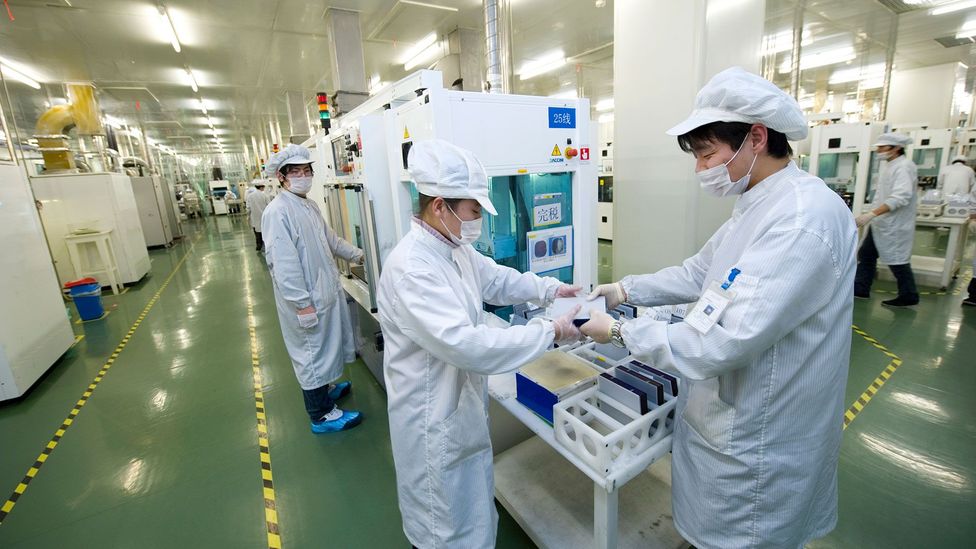
More than 60% of the earthly concern's solar panels are made in China (Credit: Getty Images)
Plus, by increasing the renewable energy resource, authorities can allow themselves a pat on the spinal column. Cleaning up the Chinese push flux is a key insurance policy objective. Roughly deuce thirds of the country's electricity still comes from burning char.
Information technology's no marvel that the vast, covered plains of north and magnetic north-western China have get along home to large solar farms. On that point's lots of space there to build them and the solar resource is reasonably time-tested. Their construction has also been restless at a blistering gait. The IEA notes that Communist China met its own 2022 target for star zip capacity additions three geezerhood early on.
There whitethorn exist another incentive behind China's drive to build star farms in both politically sensitive regions. In recent decades, many have discovered that China has been keen to encourage base investment in and around Thibet – an autonomous region that is home to many who reject China's claim on the territory. Some argue that much investment is politically impelled in part – an effort to cement Chinese government agency and patronise heathen Chinese who have touched to these areas.
One extraordinary venture uses solar panels to inflame an underground grid designed to run permafrost, so that trees will grow on the reclaimed put down. It is reportedly an attempt to make the area more appealing to Taiwanese settlers.
But building gigantic star farms in the midst of nowhere has its downsides. To realise wherefore, we demand to consider China from above over again. In 1935 geographer Hu Huanyong splendidly drew what is known As the "Hu Line" from north-east to south-important Republic of China. It divides the country into two roughly equal portions. Inferior equal is the population statistical distribution. The huge absolute majority of China's people, 94%, sleep in the Asian portion. The remaining 6% live to the west.
"The distribution of China's lead and star energy resources [is] solely the opposite," says Yuan Xu at the Chinese University of Hong Kong.
Many of the country's star panels are therefore settled as far as can be from the large towns and cities that need them. The result of this is a staggeringly scurvy capacity factor – the percentage of electrical energy really appropriated from any given imagination.
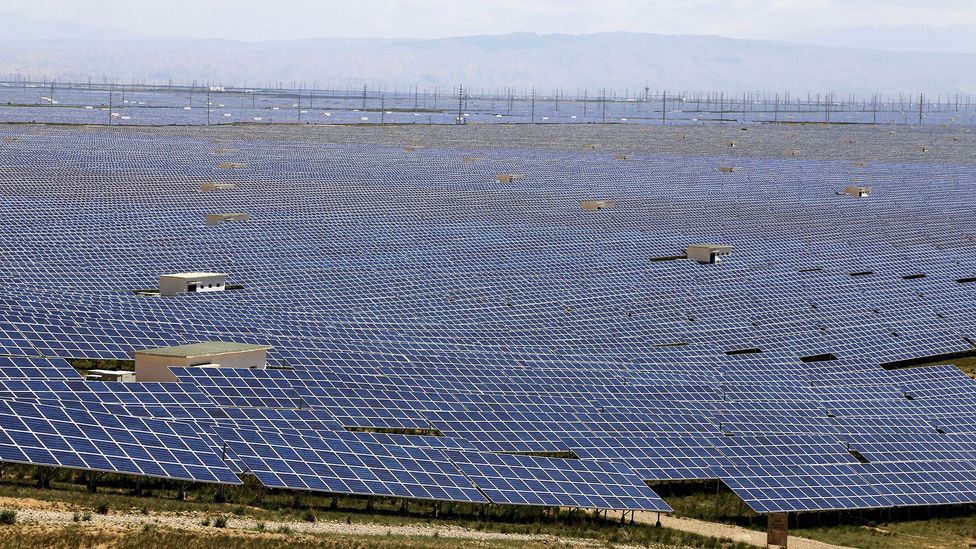
The solar farms in Qinghai make the most of the translucent skies and licking Sun above the Tibetan Plateau (Credit: Getty Images)
Citing information from the China Electricity Council, in the first-class honours degree six months of 2022, the capacity factor out of Island solar equipment was just 14.7%, says Xu. And then spell a Chinese solar farm may be billed as having a mental ability of, say, 200 megawatts, less than a sixth of that on average actually gets used.
The reasons for a low capacity factor can include things over which we have no control, such every bit the weather. But Mainland China's capacity factors are unusually low. Start out of the job, says Xu, is that power is lost on the huge transmission lines, many kilometres lengthened, that connect distant solar farms to places that need electricity. It's a situation that Xu terms a "important mismatch".
China has tried to address this release by developing better transmission line engineering science, says Jeffrey Ball at Stanford University's Steyer-Taylor Centre for Energy Policy and Finance.
Innovations include high-capacity direct current (DC) lines – but these are not being built as quickly atomic number 3 some expected.
And there's another complication presently looming large for the Chinese star diligence. In May, the regime born crucial subsidies for large musical scale solar projects, meaning they are now much more expensive to material body.
The cut in public finance has come about because the state of matter-run renewable Energy Department fund is in debt to the tune of more than $15bn. "They can't pay the subsidy anymore," says Liu. The knock-on effect is drastic. Net year, 53 gigawatts of solar capacity were installed in Republic of China. This year, Liu expects installations to total no more than 35 gigawatts – a drop of to a higher degree 30%.
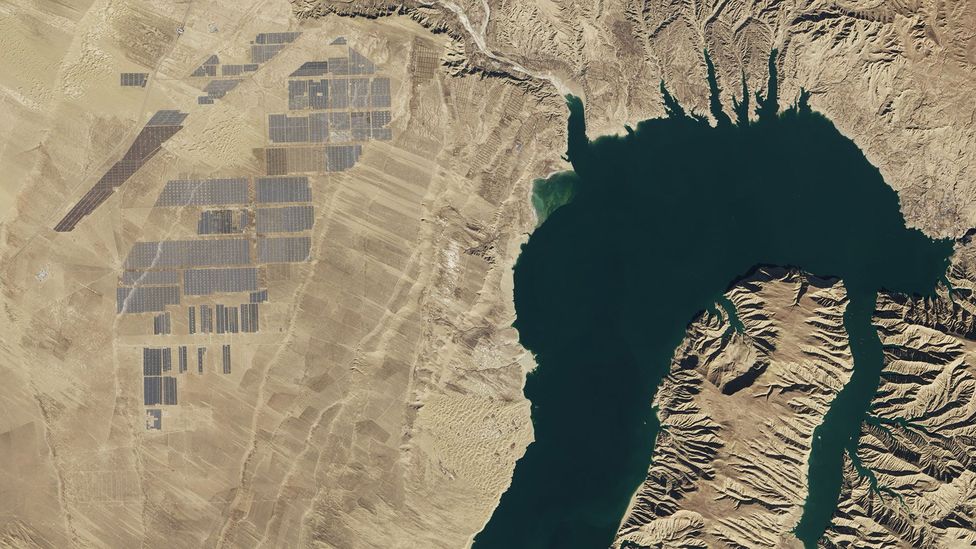
A electricity dam is connected to a solar farm at Longyangxia - it is unitary of the largest photovoltaic force Stations in the world (Deferred payment: Nasa Earth Observatory)
In much a climate, energy investors are turn off from gigantic, far solar farms, and toward new opportunities, says Liu. Covering rooftops in the big cities with star panels and selling electricity directly to consumers is a more attractive chance right now for both, she explains. Clients can be booked in arsenic these projects grow, and the Cash flow from is in theory improve, especially now that the subsidies are gone for big solar park installations.
But Liu, Ball and Xu whol agree – we have not seen the last of supersized solar farms, in China OR elsewhere.
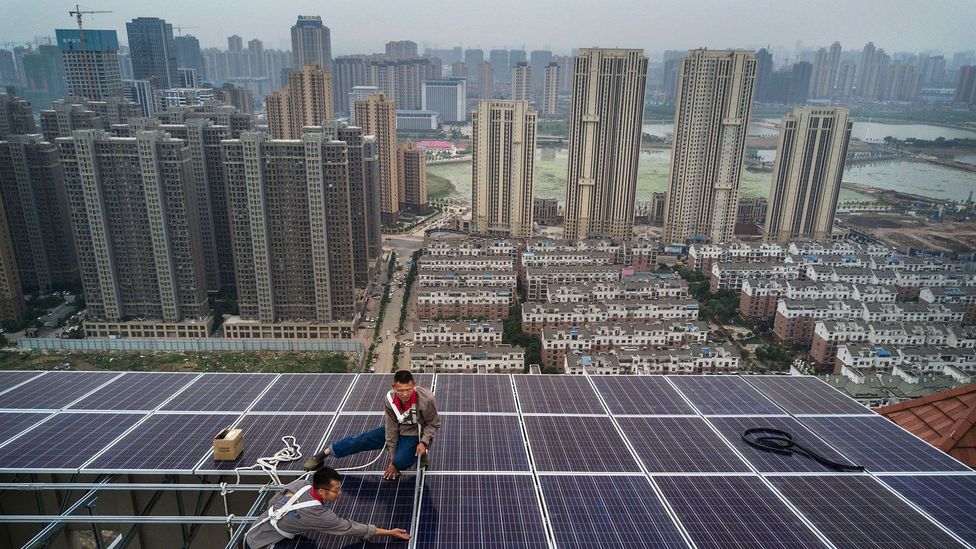
Given the inefficiency of transmittal electricity o'er large distances, rooftop solar panels tend to equal more efficient than remote star farms (Credit: Getty Images)
Elsewhere, Ailurus fulgens Green Energy, which improved the panda-shaped arrays in Datong, has plans to install many more than solar farms in Red China that look like the black-and-white bears from above. That's the goal of the tauten's "Panda 100 Program". The designers have even selected cardinal different kinds of photovoltaic cells, blue and light ones, to approximate panda markings.
The company also aims to build its eye-catching solar Parks in other countries – including what it describes as a "panda + rugger design" in Fiji and a "cat bear + maple rif intention" in Canada.
Liu points out that solar panels continue to come cheaper and cheaper. Per se, it whitethorn entirely be a a couple of years before China's slashed subsidies become irrelevant – solar power will just be too pleasurably inexpensive for investors to discount. It will be between three and five years before solar is low-budget adequate to build confidently without subsidy, she says.
But should giant star parks uphold to exist assembled, one oft-ignored tortuousness will hold to represent dealt with in rising decades: solar panel waste. The panels last just 30 age or so, after which they must be busted up. IT is hard to reuse them because they contain libellous chemicals similar element acid. China is expected to experience a sudden bunc in solar panel waste from or so 2040 onwards and there is presently nary clear plan for what to fare with completely that material.
Not quite as problematic as cell organelle waste, perhaps, but information technology is matchless more vault to overcome when ensuring that monolithic-scale solar energy real is a 'green' technology.
We're going to have to deal with that problem at some phase. As Ball explains, the huge interest in inexpensive solar power, subsidies or not, bequeath likely Pb to enormous farms in future years. "Nonetheless big these projects are that seem so huge now, there are going to have to be umteen more of them and they'Ra going to have to be even bigger," he says.
In other words, we own't seen nil yet.
Sum 900,000+ Future fans by liking USA on Facebook, or survey us on Twitter operating theater Instagram.
If you liked this story, sign up for the period of time bbc.com features newsletter, called "If You Only Read 6 Things This Week". A handpicked selection of stories from BBC Future, Culture, Capital, and Travel, delivered to your inbox every Friday.
How Much Money Does A 35 Gigawatt Solar Plat Make?
Source: https://www.bbc.com/future/article/20180822-why-china-is-transforming-the-worlds-solar-energy
Posted by: paulsonfristruither.blogspot.com
0 Response to "How Much Money Does A 35 Gigawatt Solar Plat Make?"
Post a Comment